Microfluidics allows for the precise manipulation of fluids on the small scale. For many years it has been hailed as a technology capable of revolutionising research in the chemical and biological communities.
Recently we have been interesting in developing 3D printing techniques for the production of microfluidic devices. (Read the paper here).
High equipment costs and specialised skill requirements have created a fabrication barrier that has been a key factor in limiting the uptake of microfluidics in laboratories where it could be most beneficial.
The use of relatively cheap and simple 3D printers to fabricate microfluidic devices using widely available materials could open up the possibilities of microfluidics to the wider scientific community allowing devices to be easily shared and created.
Plug and play modules can be printed to create reconfigurable microfluidic systems. Optimisation of printing conditions and materials enables the printing of transparent devices for visualisation of fluid flow or fluorescent imaging.
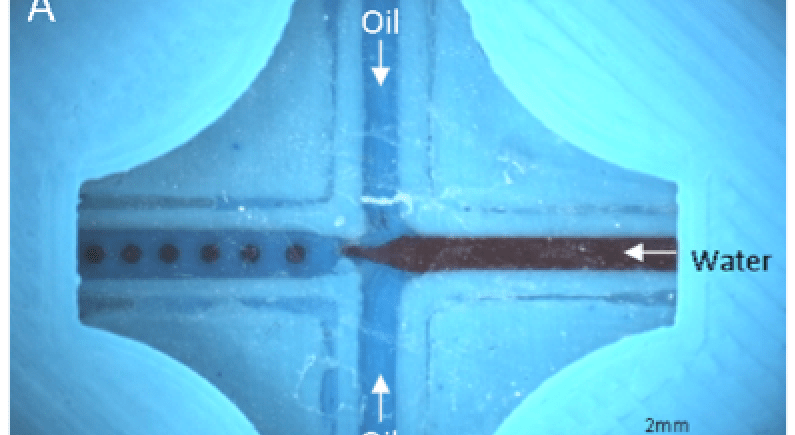
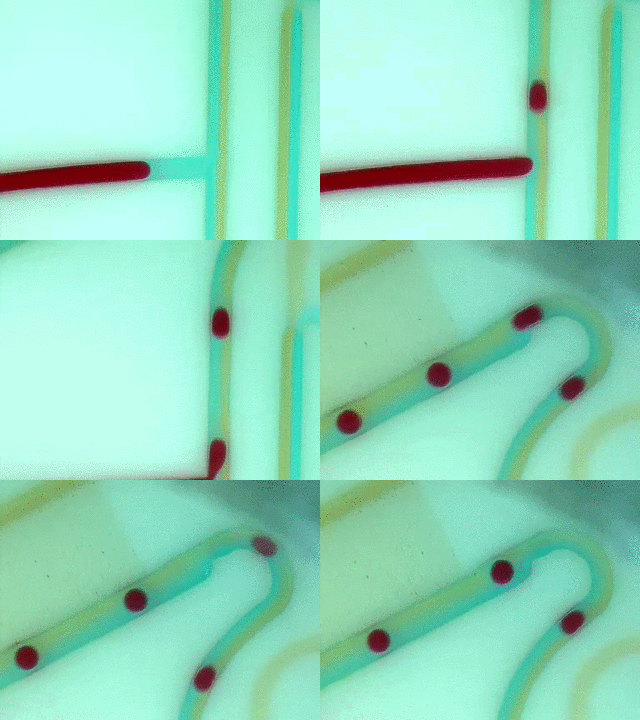
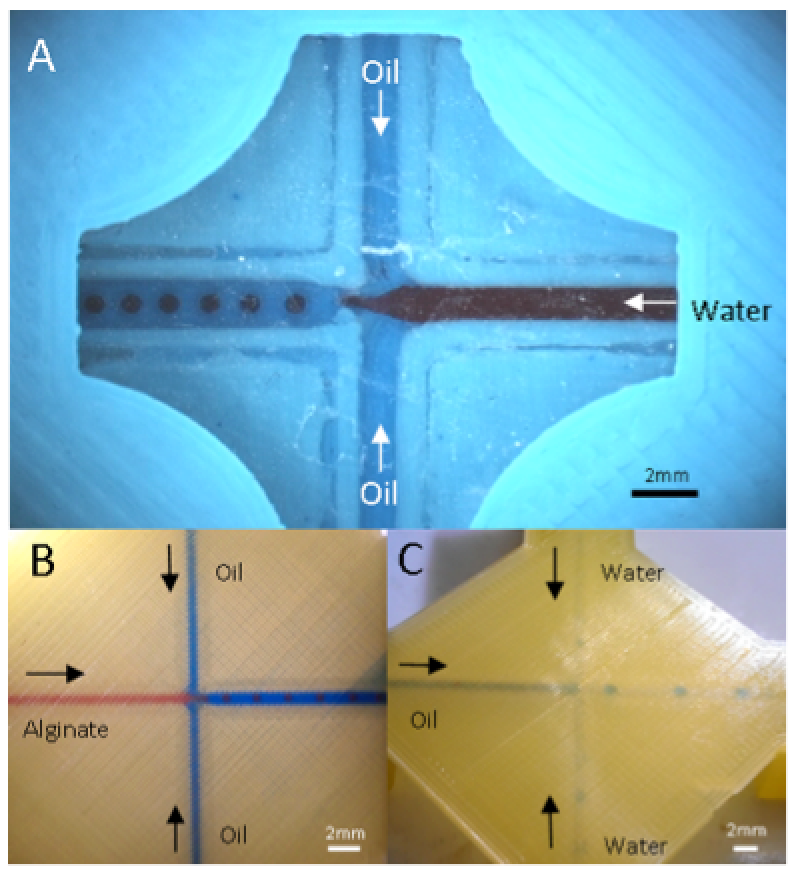
Droplet microfluidics makes use of the difference in fluid behaviour on the small scale, where surface and viscous forces dominate. Many small droplets of water in oil can be produced at a rapid rate with great regularity. Microdroplets are useful for miniaturisation of chemical reaction and rapid, high-throughput experimentation.
In collaboration with our colleagues Phil Stephens and Bing Song, we show the potential use of droplet microfluidics to encapsulate stem cells in droplet capsules. This technology enables scientists to culture cells in three-dimensional structures and create synthetic materials both supporting and protecting encapsulated cells. Such technology is expected to find use in regenerative medicine and tissue repair.
The advantageous fluid dynamics of microfluidics have made it a useful tool across the scientific disciplines with applications in cell encapsulation, DNA analysis, drug discovery, high throughput screening, cell and droplet sorting and separation, chemical synthesis, chemical separations, radiopharmaceutical production, proteomics and diagnostic technologies amongst others. The use of 3D printing to fabricate microfluidic devices using widely available materials could increase the accessibility of microfluidics to the wider scientific community allowing devices to be easily shared and created.
 Castell Lab